Can a tow truck refuse to take my car in Atlanta?
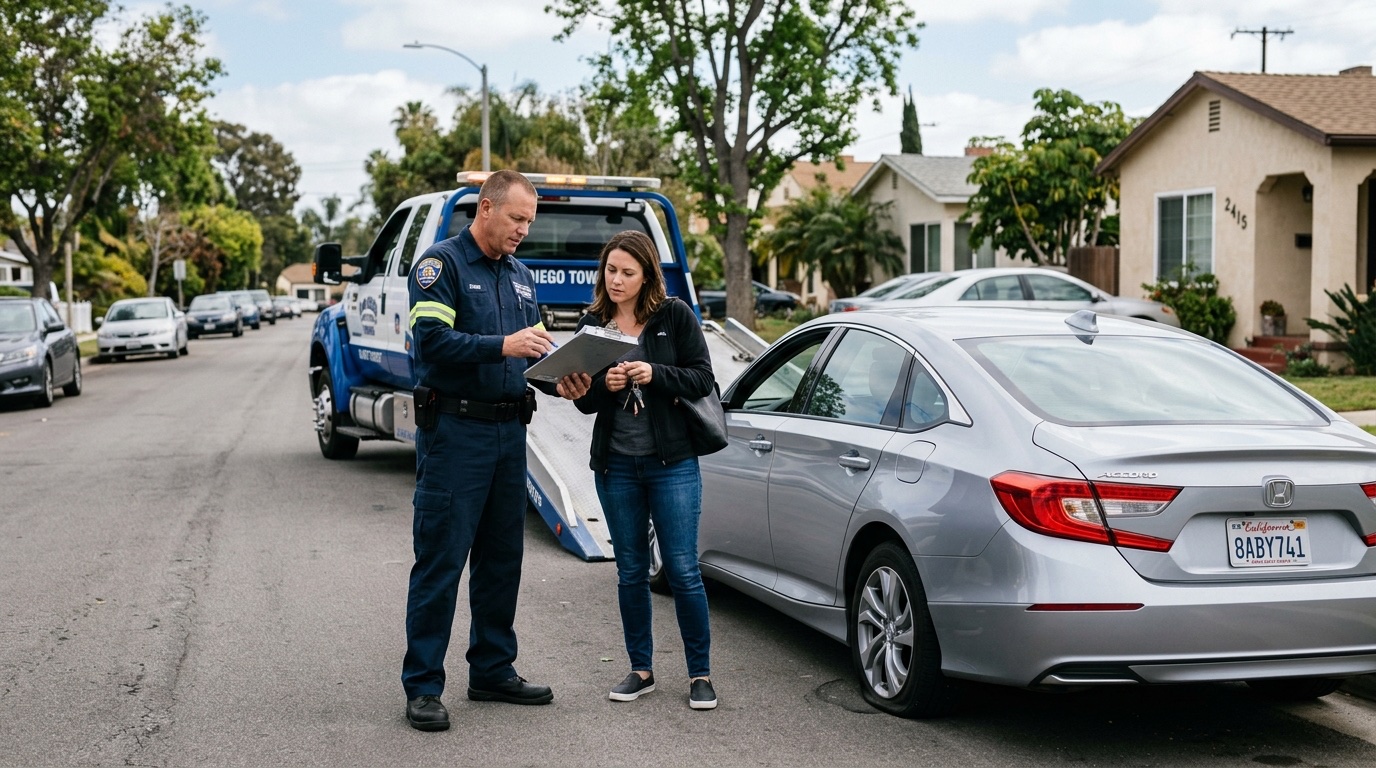
Yes, but only in specific situations, and which rules apply depends entirely on who ordered the tow. Here is when an operator can refuse, and what you are owed either way.
What you'll learn
- The legitimate reasons a Metro Atlanta tow operator can refuse a job
- The difference between a tow you order and one the city, a county or a property owner orders, and why your choice of company only applies to one of them
- What O.C.G.A. 44-1-13 requires of a private-property tow operator, and what it forbids
- Your rights as the vehicle owner if you are refused
- What changes when the breakdown happens in DeKalb, Fulton, or a suburban county
Step by step
- Reason 1 - Vehicle weight or size exceeds the truck's rated capacity, for example a standard wheel-lift truck sent to a loaded box truck or bus that needs a heavy-duty rig.
- Reason 2 - Vehicle is unsafe to tow: a hazardous fluid leak, a fire risk, or structural collapse.
- Reason 3 - The operator cannot verify ownership, with no registration and no clear vehicle-to-driver match.
- Reason 4 - The location is unsafe for the operator: an active hostile environment, no safe pull-off, a live work zone, or an expressway spot with no usable shoulder.
- Reason 5 - The operator does not service that area or that vehicle type, for example an electric vehicle call to an operator with no flatbed.
- When an operator is expected to take it: a tow you requested and chose the company for, and an insurance or motor-club dispatch on the operator they sent.
If an operator refuses and you are stranded somewhere unsafe, call 911. GDOT runs the HERO units, the Highway Emergency Response Operators who patrol the metro Atlanta freeways, and because they patrol constantly they are often first to reach a disabled vehicle. What they do is set up a safe lane closure, warn approaching traffic and help get you clear. They do not repair your car and they do not tow it to a shop.
Yes, but only for real reasons
A Metro Atlanta tow operator can refuse to take your vehicle, but only in specific situations, not because they do not feel like making the trip and not because a better-paying job is waiting. The line that matters most here is not which company shows up. It is who ordered the tow, because that single fact decides whether you have any say at all.
The legitimate reasons an operator can refuse
- The vehicle exceeds the truck's safe rating. A standard wheel-lift rig cannot safely tow a loaded box truck, a bus or a heavy commercial vehicle. This metro produces a lot of those: Hartsfield-Jackson air cargo, the freight corridors on I-285, I-75 and I-85, and the warehouse and logistics base around Forest Park and Fairburn all put heavy trucks on the road.
- The vehicle is unsafe to tow. A fuel or fluid leak, a fire risk, or a body that has lost structural integrity after a crash all change the job from a tow into a recovery, and sometimes into a job for the fire department first.
- Ownership cannot be verified. If you cannot produce a driver's licence, a registration or other proof that you have authority to move the vehicle, the operator can refuse. That is not obstruction, it is what stops a tow truck from becoming a theft tool.
- The location is unsafe for the operator. The metro Atlanta interstate system carries some of the heaviest traffic in the Southeast, and on stretches like the Downtown Connector and the Perimeter there is no usable shoulder at all. An operator who says they will not work a live lane is right.
- The operator does not serve that vehicle type or that area. An operator without a flatbed may legitimately refuse an all-wheel drive or electric vehicle, because the alternative is damaging your drivetrain.
Who ordered the tow changes everything
A tow you order
You pick the company, you agree the price before the truck rolls, and the operator either takes the job or tells you why not. This is the only category where your choice of company means anything.
A city or county tow
If Atlanta Police or a county or suburban department order the tow, you do not choose the company and you do not choose the destination. Inside the city, Atlanta Police assign a contract wrecker by police zone, and the City of Atlanta caps the towing fee at $125 with no storage charge for the first 24 hours under city ordinance section 162-227. In DeKalb County, impounded vehicles go to the county lot at 2158 Tucker Industrial Rd in Tucker, at a $125 impound fee plus $15 a day storage. In Fulton County, vehicles are released from the Fulton County Marshal admin office at 185 Central Ave SW downtown, not from the tow yard. A tow near Hartsfield-Jackson is its own case, with airport impound storage running $2.50 per day after the first day.
A private-property tow
A tow from private property in Georgia is a non-consensual tow governed by O.C.G.A. 44-1-13 and the Georgia Department of Public Safety Maximum Rate Tariff No. 5, performed by an operator holding a state non-consensual towing permit. You did not order it, you cannot choose the company, and the property owner did. What you do get is a specific set of rights, and they are worth knowing.
What the law requires of a non-consensual tow operator
- A compliant sign, or the tow is unlawful. Under O.C.G.A. 44-1-13 the sign must be posted within 50 feet of each lot entrance (or, where there is no entrance, visible from every space), be at least 12 by 18 inches with lettering at least three quarters of an inch, and state the tow company name, the retrieval address, the cost of recovery, and the accepted payment methods.
- They must stop if you arrive in time. Under the state tariff, if the vehicle is not yet hooked or loaded and the owner returns with a key and removes it immediately, no fee is charged.
- No trolling the lot. Automatic or systematic surveillance of a lot for tow purposes is unlawful. The operator must be called for each individual trespass, and a violation carries a $1,000 fine.
- No kickbacks. A payment from a tow firm to a property owner in exchange for removal rights is unlawful and carries a $1,000 fine.
- Rates capped by the state. For a vehicle at or under 10,000 pounds, Tariff No. 5 caps the tow at $228, daily storage at $33, notification charges at $91, with no storage for the first 24 hours and additional fees after 72 hours up to $65.
- A permit and a written contract. A permitted operator must post the state towing permit at the main office and carry a copy in the truck, and must have a written contract with the property owner on the DPS form. A non-consensual tow requires a same-day request from the owner or agent.
Counties and suburbs are not the city
The City of Atlanta caps the towing fee at $125. DeKalb County runs its own lot in Tucker at $125 plus $15 a day. Fulton County releases impounds from the Marshal admin office downtown. The outer counties each run their own impound and process. If you are outside the city, the first step is to call the department or agency that ordered the tow and ask where the vehicle is and what the fee is, because the destination and the number are not the same from county to county.
What to do if you are refused
- Ask why, and write it down. A legitimate refusal has a specific reason attached to it, and an operator who cannot give one is telling you something.
- If you are somewhere unsafe, call 911. GDOT's HERO units patrol the metro freeways to clear hazards and protect responders, but they are a patrol rather than a call-out service and they do not tow your vehicle to a shop.
- Call a company that runs the right equipment. A refusal on capacity or vehicle type is a routing problem, not a dead end. Leave exactly what the vehicle is and where it sits.
- For a private-property tow you believe was unlawful, complain to the regulator. The Georgia Department of Public Safety administers non-consensual towing permits and the maximum rate tariff. Keep your invoice and note the times.
Patterns we see across this metro
- No-shoulder refusals. A driver stopped on the Downtown Connector or the Perimeter where there is nowhere to set up gets told to wait. That is usually the right call, and the fix is a scene set up properly rather than a faster truck.
- Out-of-town and rental refusals. A traveller in a rental near Hartsfield-Jackson, a student car registered in another state, or a driver passing through on I-75 or I-20 all run into ownership-verification problems more often than locals do.
- Heavy-duty cascades on the freight corridors. A truck fails on I-285 or I-75, a light-duty rig arrives, and nothing can happen until a properly rated wrecker is dispatched. Confirming weight and load on the first call prevents the whole sequence.
- Ice and storm surges. When a rare ice storm hits, the metro's thin treatment capacity means every operator is committed at once, the way the 2014 storm stranded cars across I-285, I-75 and I-85. On the worst nights the honest answer is a longer wait, not a refusal.
Numbers worth keeping
- DeKalb County impound lot - (770) 493-9083, 2158 Tucker Industrial Rd, Tucker, for a DeKalb police tow.
- Fulton County Marshal admin office - (404) 612-5100, 185 Central Ave SW, where Fulton impounds are released.
- The department that ordered the tow - for a city or suburban police tow, call the agency that ordered it to find the vehicle and the fee.
- 911 - when you are stranded somewhere unsafe on a metro freeway.
Rather have a pro handle it?
Towing and roadside service across Metro Atlanta. One local line, taking calls 24/7.
Keep learning.
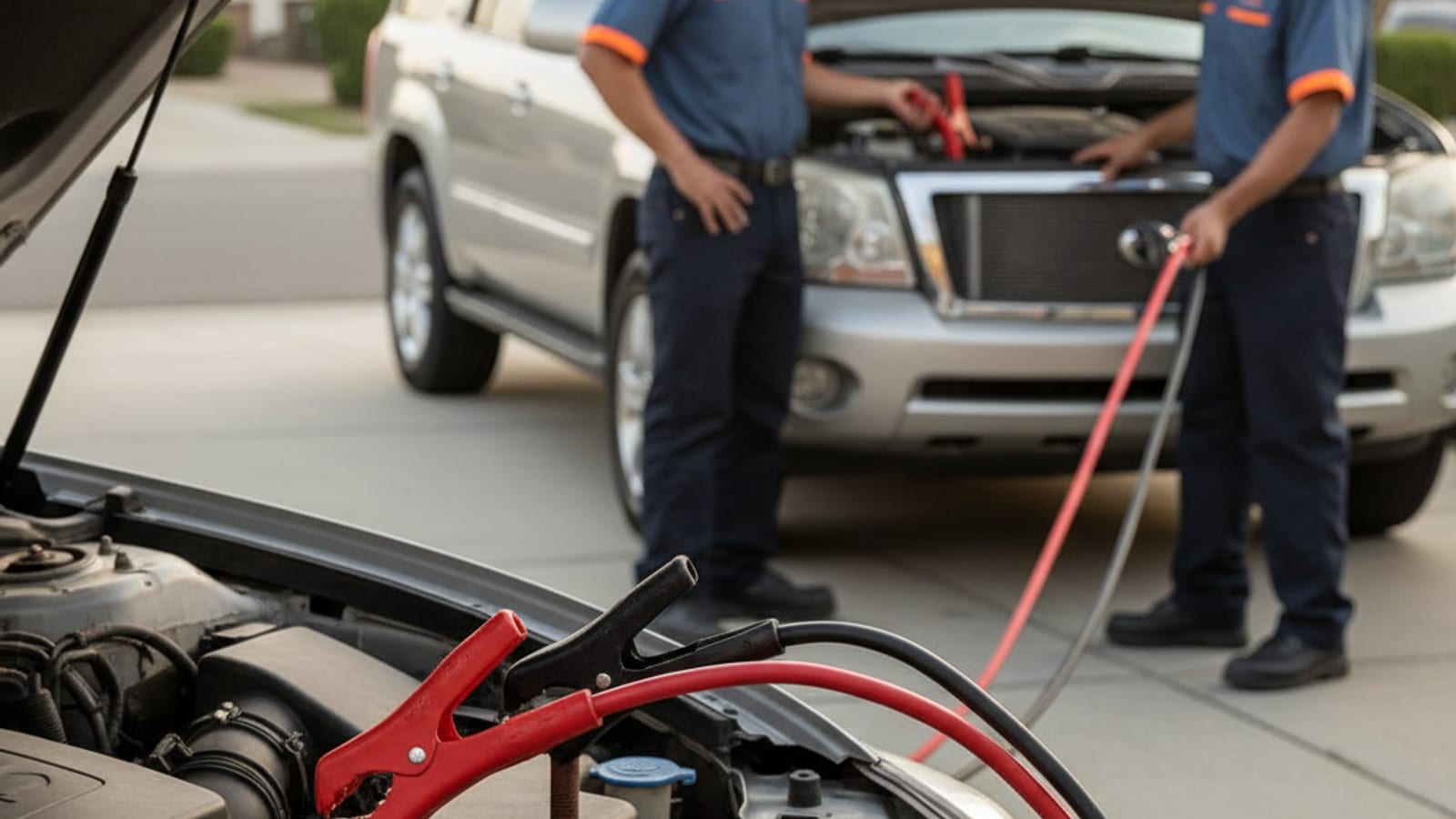
Jump-start a dead battery safely
Jumper cables are simple until you hook them wrong. Do it right and you'll avoid sparks, ruined electronics, and a tow you didn't need.
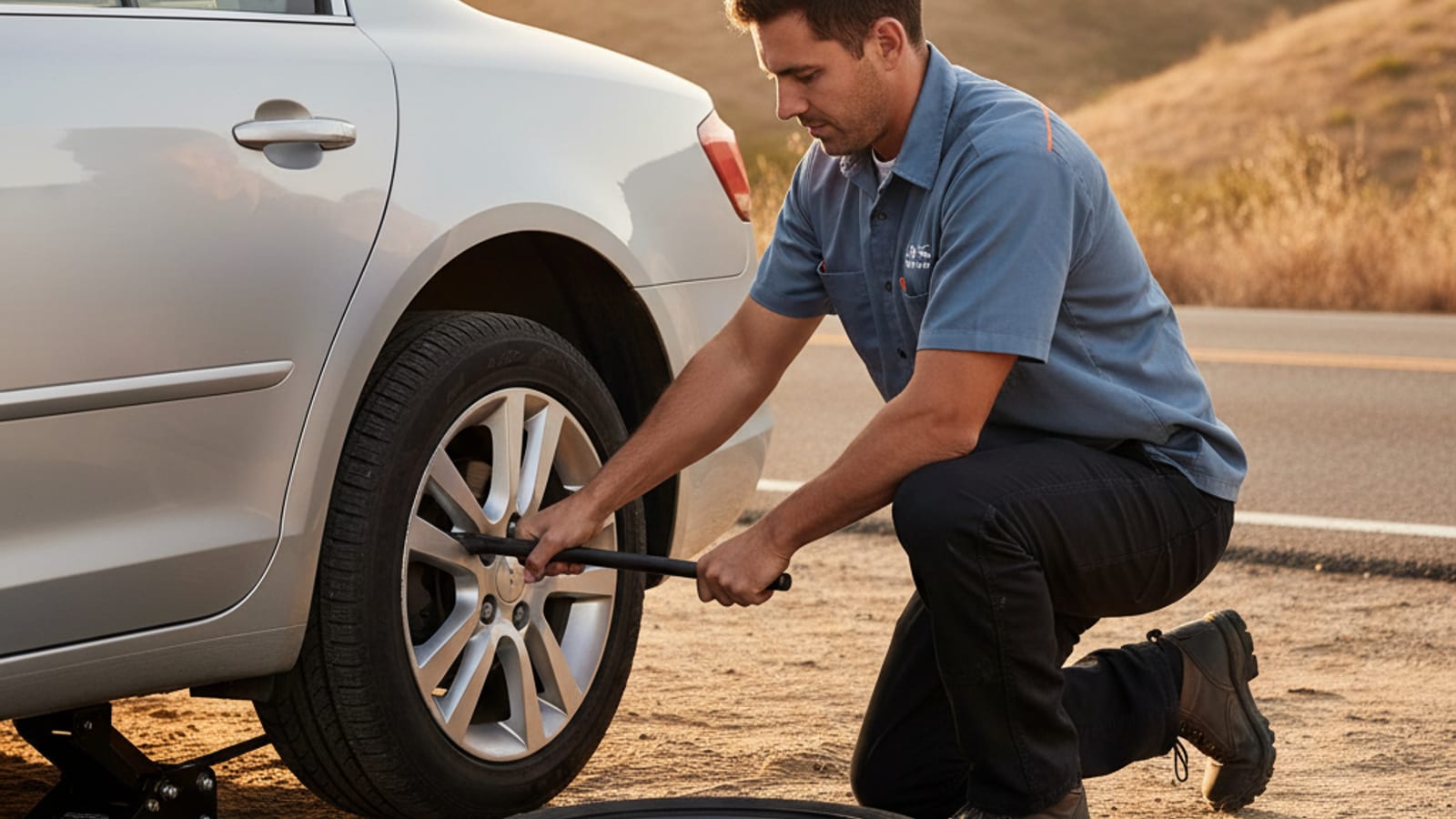
Change a flat tire on the side of the road
The difference between a 20-minute shoulder stop and an hour on the phone with a tow company is knowing where the spare and jack live before you need them.
What to do if you slide on ice or hit a flooded road
Atlanta ice storms are rare, but they glaze bridges and ramps before flat roads, and a hard summer rain fills a low-lying road or underpass faster than it looks. First step: stop making it worse.