You’re stuck in a Midtown deck or on the shoulder of the Downtown Connector, and the truck type matters more than the mile marker. A wheel-lift wrecker lifts two wheels. A flatbed, the rollback, carries the whole car off the pavement.
When a wheel-lift is enough
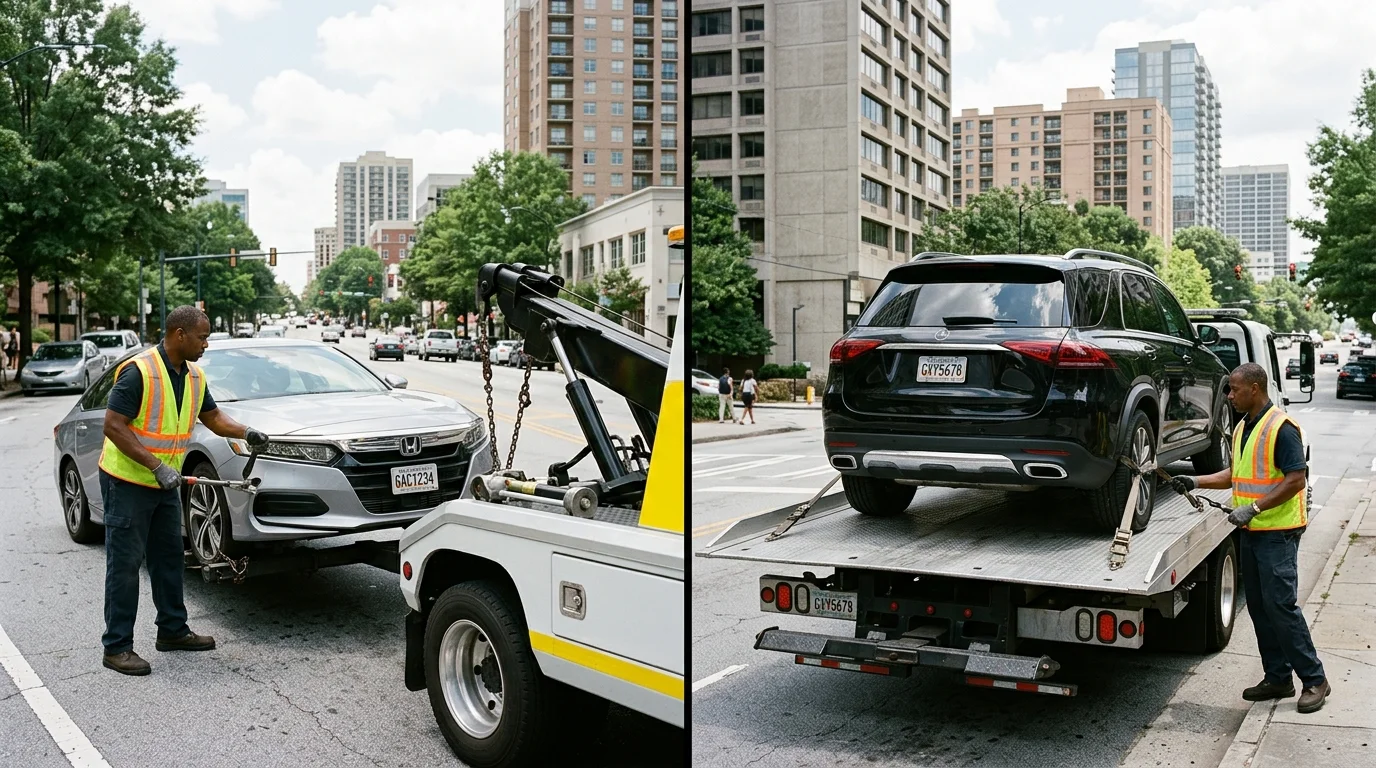
A wheel-lift is the light-duty wrecker you see on Peachtree and on I-285. The operator we send lifts the front or the rear. The other two tires roll, or they ride on dollies if they can’t spin.
That setup is enough for a lot of four-wheel passenger cars. A front-drive sedan that still rolls. A rear-drive coupe that isn’t slammed. A dead battery in Virginia-Highland, an overheat on Ponce, a flat you already changed on North Avenue. If the drivetrain is two-wheel drive, the ride height is stock, and the wheels turn, a wheel-lift is often the tool the operator reaches for.
It’s also the truck that fits a tight hole. A rollback needs a long, straight lane to tilt and load. A wheel-lift can work a curb lane on the Connector, a Buckhead office drive, or a one-way under the Brookwood split. That’s why you still see them on every Atlanta shift.
A wheel-lift is the wrong default when the car is all-wheel drive, sitting on a low kit, or carrying a battery pack under the floor. It’s the wrong default when a wheel is locked, a CV axle is torn, or the car has been in a crash. The operator on scene still makes the safety call. You can still ask for a flatbed when you call.
If you’re on a metro freeway, GDOT HERO may already be on the shoulder. HERO units move a disabled car out of a live lane and help with a spare or a jump. They don’t tow you to a shop in Decatur or a dealer in Sandy Springs. Once the car has to leave the road for a bay, you’re in a consensual tow. That’s a different call.
Stay in the car if the shoulder is narrow. The Grady Curve and the Connector’s left-side breakdowns don’t give you a lawn to stand on. Hazards on. Let the operator we send work the traffic side.
AWD, low body kits, and EVs that should ride a flatbed
North Fulton is full of AWD crossovers. RAV4s, X3s, Highlanders, and Macans on GA-400 and in Alpharetta office parks. A lot of them look like ordinary SUVs. They aren’t two-wheel-drive Camrys. Lift one axle and tow, and the other axle can still turn the transfer case. That’s how a center differential gets wrecked on the way to a shop.
Tell the line the car is AWD or 4WD. Don’t assume the operator can read it off a badge from the street. Some crossovers hide the drivetrain on a window sticker. If you’re not sure, say so. The safe ask is a flatbed. All four wheels leave the pavement. Nothing in the driveline has to turn.
Low kits are the other Atlanta tell. A lowered 3-series in a Buckhead garage. A sports sedan with a splitter on West Peachtree. A bagged car on the Midtown deck ramps. A wheel-lift’s forks and crossbar sit right where that bumper and that oil pan want to be. Loading onto a rollback with a winch and ramps, or with wheel scoops, keeps the nose off the steel. Exotic and classic towing in Atlanta is the low-car load page. Tesla and EV towing is the Transport Mode page.
EVs add weight and a pack under the floor. A Model 3, an Ioniq, a Mustang Mach-E in Atlantic Station. You don’t want forks hunting for a pinch weld next to a traction battery. We could not confirm a Georgia rule that names EVs as a special tow class. The practical point still stands. Keep the car’s belly off the wrecker. Ask for a flatbed and say it’s an EV.
Luxury cars belong on the same list for the same reasons: ride height, wide tires, and bodywork that doesn’t survive a scrape. This is a four-wheel passenger-car problem. Two-wheelers are a different load and a different truck setup.
If the operator we send looks at the car and says the rollback won’t fit the deck, listen. Forcing a long bed up a Midtown spiral is how you scrape a bumper that was fine five minutes ago. The request is yours. The equipment call on scene is theirs.
Downtown decks, speed bumps, and clearance problems
Midtown and Buckhead decks are their own job. Steep entrance ramps. Pipe gates. Speed tables. Concrete noses that kiss a splitter. A Camaro coming down the 10th Street deck, a G70 in a Peachtree Center garage, a low Audi under Colony Square. The underbody is the clearance problem, not the roof.
A rollback needs room to tilt and winch. Many downtown decks don’t give that room. The operator may hook you in the alley, on the street level, or on a floor that opens to the sky. Sometimes the right move is a wheel-lift plus dollies, then a short drag to a place the flatbed can load. That’s an on-scene call. We don’t promise which truck will fit your garage.
Speed bumps and speed tables show up off the decks too. Piedmont Park edges. Atlantic Station. BeltLine crossings. Apartment entries in Grant Park and along Buford Highway. A slammed car that cleared the driveway at walking speed will not clear a wrecker boom at the same height. Say the car is lowered before anyone is rolling.
On the Connector and I-285, clearance is about the truck, not only the car. Shoulders pinch. Jersey wall. A long bed that can’t square up to the car is a hazard of its own. The operator we dispatch picks equipment for the lane they actually have, not the lane you wish you had. Spaghetti Junction, the Brookwood split, and the Peach Pass approaches don’t leave extra pavement.
If you’re in a private garage and the car was already hooked by a lot wrecker, stop. That’s a non-consensual private-property tow under O.C.G.A. § 44-1-13. Different rules, a different rate ceiling, a different retrieval. This page is the call you make when you want the car moved.
Accident scenes versus a simple breakdown
A simple breakdown is a car that still has its shape. Dead battery on West Peachtree. Overheat on I-20 east of the Connector. Flat on the Cobb side of I-285. If the wheels are round and the body is off the ground, the operator can often treat it as a rolling load. Sometimes roadside help is enough and you never need a wrecker.
An accident scene is a different picture. Airbags out. A wheel tucked under. Fluids on the asphalt. A car that will not roll onto a wrecker even with dollies. That’s when a winch and a flatbed earn their keep. The operator we send is there to recover the car without dragging a control arm down the Connector.
If police ordered the tow, you’re not in a consensual roadside call. The City of Atlanta contracts wreckers by police zone. The assigned wrecker releases the vehicle. Under Atlanta Code § 162-227, that police tow is capped at $125 with no storage for the first 24 hours. That cap is not a quote for a rollback you requested. Don’t mix the two.
A crash on a surface street in Midtown, with no officer holding the car, is still your call. Tell the line it’s an accident, whether the car rolls, and where you want it. Accident recovery is the service, not a wheel-lift by default.
Don’t stand in a live lane to take photos. The Connector through downtown, Spaghetti Junction, and the Brookwood split don’t forgive a person outside the sheet metal. Hazards on. Wait for the operator we send.
What to ask for on the call, without a brand price list
Have this ready before you dial. Where you are: deck name and level, cross streets, or a mile marker on I-75, I-85, I-285, or GA-400. What the car is: make, model, year if you know it. Whether it’s AWD, lowered, or an EV. Whether it rolls. Where it needs to go.
Then ask, in plain words, for a flatbed if you think you need one. “Please send a rollback” is a request. It isn’t a promise. The operator we dispatch still chooses equipment for safety and for the hole they have to work in. If a flatbed can’t enter the deck, they’ll tell you that on the way, or on scene.
Ask for the price before anyone is dispatched. On a consensual call, the one you make, there is no statutory rate cap. The operator sets the number and quotes it first. We don’t publish a brand price list. We don’t quote a flat rate here. The Georgia DPS Maximum Rate Tariff No. 5 is a ceiling for non-consensual private-property tows, not a menu for this job.
People search how much it costs to tow a car on a flatbed, and whether flatbed towing is more expensive. A rollback can take more time and a larger truck. Some operators price it higher. Some don’t. Treat any figure you haven’t heard on your own call as noise. “How much is a flatbed tow truck” is a purchase question for a dealer. It isn’t your roadside quote.
The so-called 80/20 rule that shows up in search is about trailer tongue weight. We could not confirm any Georgia towing statute or DPS tariff that uses an 80/20 split to pick a wheel-lift or a flatbed. Ignore it on this call.
If you’re still choosing who to call, start with how to get a tow truck near you in Atlanta. Then get on the line with the facts above. Flatbed towing in Atlanta is a request plus an on-scene call, not a catalog you order from.
When to call us
When the car won’t roll, sits too low for a wrecker boom, is AWD or an EV, or is sitting in a live lane of the Connector, this is past a spare-tire job. The line takes calls 24 hours a day in English and Spanish. Calls are recorded after a notice, and we dispatch an independent local operator to you. Call us at (678) 379-5984.