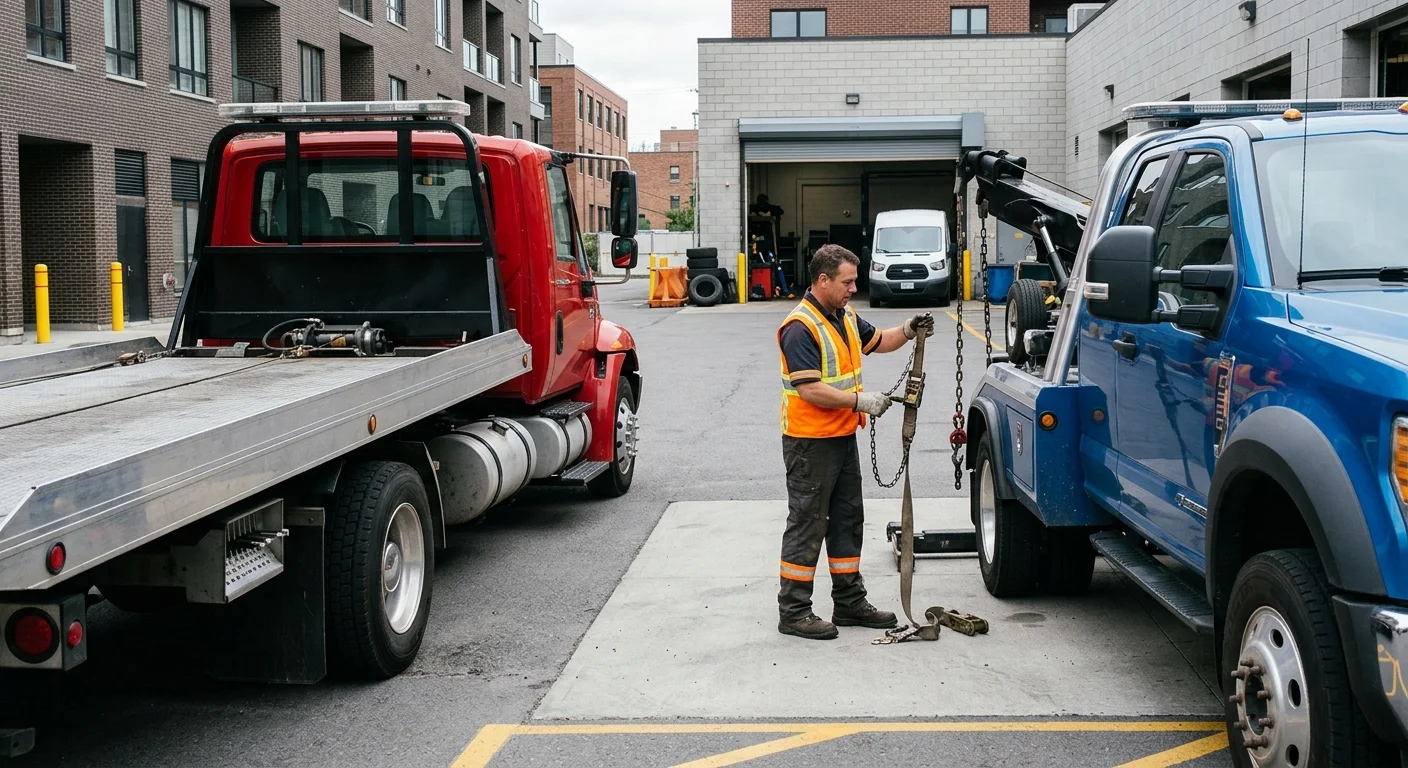
A tow truck near you in metro Atlanta is rarely one truck on one corner. The metro is five core counties plus a long haul ring, ten named corridors that all raise different scene questions, and apartment, retail, and event lots that follow their own rules. The fastest way to reach an operator who actually works your stretch is to call a line that knows the local rotation, name your location plainly, and get a quoted total before the truck rolls.
This brand is a referral service. It connects drivers in Fulton, DeKalb, Cobb, Gwinnett, and Clayton counties with independent licensed tow operators. It does not own trucks, hold a tow license, or set operator rates. The line takes calls 24/7 in English and Spanish.
What the dispatcher needs from you
Before the operator can quote or roll, the dispatcher needs enough to route the call and choose the right truck:
- Where the car is. A specific location is better than a corridor name. “I-285 westbound at Ashford Dunwoody” beats “I-285.” Surface streets work the same way. The Downtown Connector (I-75/85), Spaghetti Junction (I-285/I-85), GA-400, I-20, I-75, I-575, I-675, and the Buford Highway (GA-13) corridor each raise different scene questions.
- Where the car needs to go. A shop you chose, your driveway, a storage yard, or the nearest safe drop.
- The vehicle. Year, make, model, drivetrain (RWD, FWD, AWD, 4WD), and any damage or low ground clearance. EVs and motorcycles need particular equipment.
- The situation. Mechanical, accident, flat tire, dead battery, lockout, out of fuel, stuck (mud, sand, snow, parking garage stall), or a repossession question. A wrong truck at the scene wastes an hour.
- Your callback number. The operator may need to ask a follow up before rolling.
If the situation is a private property tow from an apartment, retail, or HOA lot, that is a non-consensual tow under O.C.G.A. § 44-1-13. The lot owner calls the operator, not you, and the operator must follow the signage, no patrol, and same day call rules. The Atlanta private property towing rights page walks that path.
What the line will not promise
The dispatcher will not quote an arrival time. Independent operators set their own arrival estimates for their current run, and traffic on the Connector, I-285, or GA-400 can stretch a 20-minute ETA into an hour. The dispatcher will not quote a final price. The operator who accepts the job quotes that vehicle and that route. Tariff No. 5 ceilings ($228 tow / $33 per day / first 24 hours free / $91 notification cap) cap private property tows in Georgia; the City of Atlanta police tow caps at $125 with first 24 hours free (Atlanta Code § 162-227). For consensual roadside calls, the operator’s quote is the price.
Which corridor, which truck
A short list of how the metro’s named corridors raise different scene questions:
- Downtown Connector (I-75/85). The Grady Curve and the Brookwood split are named trouble spots. Most stalls clear to the nearest shoulder; a freeway shoulder pickup typically uses a wheel lift or fast response flatbed.
- I-285 “the Perimeter.” A 64 mile beltway around the core. Crash heavy stretches include the east side near Spaghetti Junction and the west side near the I-20 interchange. Recovery work needs a wrecker with traffic control.
- Spaghetti Junction (I-285/I-85). 200,000+ vehicles per day, short weave zones, and the I-85 bridge collapse site at the Brookwood split. Recovery here can take an hour.
- GA-400. North Fulton’s spine. Affluent recoveries, AWD and EV heavy.
- Buford Highway (GA-13). Surface street crashes through Chamblee, Doraville, and Norcross. Spanish is the primary community language on this corridor.
- I-75 (north). Marietta, Kennesaw, Acworth. Truck corridor; Truist Park game day traffic.
- I-75 (south). McDonough, Stockbridge, Henry County. FL bound truck traffic and the Peach Pass express lanes.
- Hartsfield-Jackson area. Airport shoulder stops, ride share waits, and event night tows. Illegal parking fines run $50 to over $350 plus tow and impound.
If you are in a long haul ring county (Cherokee, Henry, Douglas, Rockdale, Fayette, Paulding), expect an honest out of area fee on top of the operator’s quote.
Frequently asked questions
Is there a 24/7 tow line in Atlanta?
Yes. The line takes calls 24/7 in English and Spanish at (678) 379-5984 and matches you with an independent operator who runs your corridor. It is not a national call center.
How fast can a tow truck reach me in Atlanta?
The operator sets the arrival estimate for that call. The dispatcher does not promise an ETA. Freeway traffic on the Connector, I-285, or GA-400 can stretch the estimate.
Do you charge a dispatch fee?
Any dispatch or service fee is on the operator’s quote. Ask before the truck rolls. The Tariff No. 5 ceiling for private property tows in Georgia is $228 for the tow and $91 cap on total notification charges, and Tariff No. 5 caps do not apply to a consensual call.
What if my car is at Hartsfield-Jackson and was towed?
Call the airport’s parking office to confirm which contractor holds the vehicle. Airport impound storage is $2.50 per day after the first day. The current contractor is not confirmed in our research; verify before you drive out.
Will my car be damaged by the tow?
A clean operator chooses equipment the manufacturer and the scene require. AWD, EV, lowered, or damaged vehicles often need a flatbed. The flatbed towing and wheel lift towing pages explain method specific inputs.
Need a quote for a breakdown in metro Atlanta? Call (678) 379-5984. The operator who accepts the work sets the price for that job.