A crash on the Downtown Connector and a crash on I-285 are not the same recovery. One sits between walls and live lanes that carry more than 400,000 vehicles a day. The other sits on a 64-mile Perimeter with more grass, more ramps, and a longer walk to a safe spot. Accident recovery in Atlanta for a passenger car starts with that ground. The operator we dispatch does the winch, the lift, and the haul.
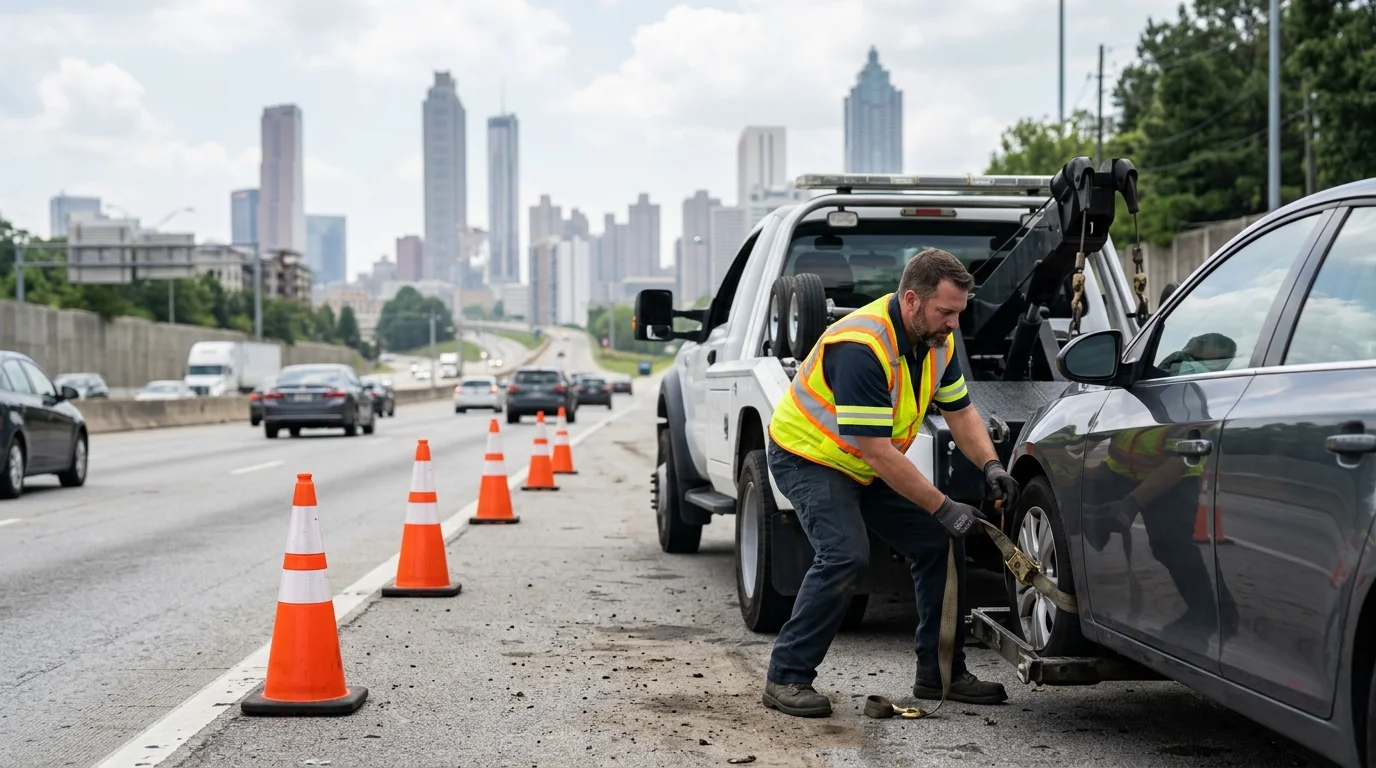
A crash on the Connector versus a crash on the Perimeter
The Downtown Connector is I-75 and I-85 stacked through the core. North of downtown you hit the Brookwood split. South of it you hit the Grady Curve, by Grady Memorial. Shoulders get thin. Concrete sits close. A passenger car in a travel lane there is a lane-clearing job first.
Georgia Department of Transportation Highway Emergency Response Operators, known as HERO units, patrol those freeways. They move hazards and help stranded drivers. They do not tow your car to a shop. That part is a wrecker. GDOT’s HERO page is the agency’s own description of that patrol.
I-285 is a different shape. Sixty-four miles of loop. Inner loop and outer loop. Longer gore points. A car that left the pavement near Northside Drive or the I-20 mix may sit far enough off that a winch is the first tool. A car still in the number-one lane on the Connector is not.
Who ordered the tow changes the next hour. If Atlanta Police Department orders the wrecker, you are in a police impound. The City of Atlanta caps that towing fee at $125, with no storage for the first 24 hours, under Atlanta Code § 162-227. Cash, check, debit, or a major card, and no surcharge on that city fee. APD contracts wreckers by police zone. We do not name those contractors here. The public list we can confirm is dated, so the current assignment has to come from the zone process.
If you, your insurer, or your club call for the car, that is a consensual recovery. There is no statutory cap on that quote. The operator we send prices it before the truck rolls. Do not mix the two. The $125 city cap is not what a private lot charges, and it is not our rate.
Fulton, DeKalb, Cobb, Gwinnett, and Clayton each run their own police-tow path when it is their scene. Cobb, Gwinnett, and Clayton administrative fees are not confirmed in our files, so we will not invent them. Ask the agency that ordered the tow. Emergency towing in Atlanta on these roads is still a passenger-car job until someone tells dispatch it is a box truck or a tractor-trailer.
Winch-out, wheel-lift, or a heavier wrecker
Most passenger crashes on these roads need one of three tools.
A winch-out is for a car that left the pavement, sat in a ditch, or hung on a slope. The operator we send sets a line, controls the pull, and gets the car back to a surface that can take a lift. Do not try that with a strap from a pickup. Wrong angle, wrong tree, and you add a second wreck.
A wheel-lift is the common highway pickup when the car still rolls and the frame is sound. The truck picks an axle and moves the car off the Connector or the Perimeter. After a crash, a flatbed is often the better haul if the wheels are locked, the airbags blew, or the suspension folded. For that choice in plain terms, read flatbed versus wheel-lift towing in Atlanta.
A heavier wrecker, and sometimes a rotator, shows up when the car is pinned, rolled, or sitting under a rail. Quick Tow Atlanta does not own rotators, wreckers, or a fleet. We refer the call. The operators we dispatch run that equipment. The pros we connect you with are licensed and insured. If the scene is a box truck or a tractor-trailer, that is a different job: heavy-duty towing. This page is the sedan, the SUV, and the pickup.
On a consensual crash call, the operator sets the quote. Georgia DPS Maximum Rate Tariff No. 5 is a ceiling for non-consensual private-property tows on vehicles 10,000 pounds GVWR or under. It is not the price of a crash recovery you asked for, and we will not treat it as one. A heavy-duty ceiling for a rotator on a passenger car is not in our claims file, so we will not invent it. You get the number from the operator before dispatch.
Tell the line what you see. A car on all four tires on the shoulder is one truck. A car on its side in the I-285 median is another.
What to tell dispatch: lanes, fluids, and airbags
Call 911 first if anyone is hurt, if the car is in a live lane, or if fuel is down. Grady Memorial is the Level I trauma center downtown. The wrecker call comes after people are out of the roadway.
When you reach us, give the road, the direction, and a landmark a driver who works Atlanta will know. On the Connector, say northbound or southbound. Name the Grady Curve, the Brookwood split, Freedom Parkway, University Avenue, or the I-20 split if you are near them. On I-285, say inner loop or outer loop, and the cross road: GA-400, I-75, I-85, I-20, or the exit you just passed.
Then the scene facts that change the rig.
Lanes. Is the car fully on the shoulder, in a gore, or still clipping a travel lane. Cones and a taper are the operator’s problem. Knowing the lane count is yours.
Fluids. Coolant, oil, and fuel on concrete change how they walk up. Say if you smell gas. Say if the engine is still on.
Airbags. Deployed bags usually mean the car is not driving off. They also mean a flatbed is more likely than a simple wheel-lift.
Wheels. All four on the ground, two in the grass, or the car on a rail. That is the winch question.
People. Everyone out. Doors that will not open. A child seat still in the back that you want with the car.
County. The Connector cuts Fulton. I-285 cuts Fulton, DeKalb, Cobb, and Clayton depending on the mile. Spaghetti Junction sits in DeKalb. The operator we send needs that, because the police agency on scene is not always APD.
If a HERO unit or an officer is already there, say so. They often decide whether the car can sit or has to move now.
This is not a delayed-shock clinic, and it is not a news desk for what happened on 285 today. If you feel wrong hours later, that is medical care. If you need the crash record, that is the police report from the agency that worked the scene. Our line is the car.
For how the phone line works on a regular, non-crash call, see how to get a tow truck near you in Atlanta.
Spaghetti Junction and GA-400 recovery
The Tom Moreland Interchange is where I-285 meets I-85 on the northeast side. Locals call it Spaghetti Junction. The ramps stack. Sight lines drop. A car that stops on a flyover has almost no shoulder and a long drop beside the barrier.
Recovery there is slow because the truck has to reach the same ramp you are on, not the one that looks close from the air. Give the operator the movement you were making: I-85 north to I-285 east, I-285 west to I-85 south, and so on. “I’m at Spaghetti Junction” is a start. The movement is the useful part.
GA-400 from the Connector north through Sandy Springs and into North Fulton is a different corridor again. Peach Pass lanes sit in the middle. A crash in a general-purpose lane is not the same stop as a car in an express lane with a wall on both sides. Say which. The operator we dispatch cannot guess the barrier.
North Fulton along GA-400 does not drive like Buford Highway. Buford Highway, GA-13, through Doraville, Chamblee, and Norcross is a surface arterial: more lights, more driveways. A crash there can often take a standard wheel-lift once the car is out of the travel lane. A crash on a 400 flyover cannot.
If the car rolled beyond the rail, expect a winch and a longer setup. If it is still a passenger car, stay on this recovery path. If it is a tractor-trailer hanging on the same ramp, that call belongs with heavy-duty towing in Atlanta, not with a wheel-lift built for a sedan.
We serve Fulton, DeKalb, Cobb, Gwinnett, and Clayton, plus the outer ring as long haul: Cherokee, Henry, Douglas, Rockdale, Fayette, and Paulding. The truck that shows is a local operator, not a yard we own.
After the scene: the car, the lot, and the quote
Once the car is on the truck, you still have three questions: where it goes, who holds it, and what you pay.
On a consensual call, you pick the destination when you can. Home, a shop you name, or the operator’s storage if you have not chosen yet. The price is quoted before dispatch. It is not a flat brand rate. It is not the city $125 rule, because that rule is for a police-ordered Atlanta wrecker, not for a call you placed.
Pay attention to storage if the car sits. Georgia’s abandoned-vehicle clock under O.C.G.A. § 40-11-1 is 30 days in the situations that statute names, including a car left at a shop past the agreed time. That is not a police-impound hold. Do not treat them as the same. The statute is O.C.G.A. § 40-11-1.
If police ordered the tow, you are retrieving from an impound process, not from our referral. City of Atlanta: $125 to tow, no storage the first 24 hours, per the code linked above. DeKalb County’s lot is at 2158 Tucker Industrial Rd, Tucker. The verified DeKalb figures are $125 to impound and $15 per day to store. A $30-per-day figure has been discussed in public debate. It is not the verified current rate, so we will not print it as fact. Fulton County releases from the Marshal admin office at 185 Central Ave SW, 9th Floor, Atlanta 30303, not from the tow yard. Use Fulton’s own release page for hours and steps.
Cobb, Gwinnett, and Clayton release rules are their own. We could not confirm a publishable fee for those counties, so ask the agency that towed the car.
Private-property tows are a third track. Those sit under O.C.G.A. § 44-1-13 and Georgia DPS Maximum Rate Tariff No. 5. A crash on I-285 is usually not that track. Do not let a lot mix the numbers.
Keep the quote on the recorded line. Georgia is a one-party consent state. Our line plays a recording notice, then takes the call.
When to call us
If the car cannot roll, if it is in a Connector lane, in Perimeter grass, or hung on a Spaghetti Junction ramp, this is no longer a self-move. Call us at (678) 379-5984. The line takes calls 24 hours a day in English and Spanish, plays a recording notice, and we dispatch an independent local operator to you.