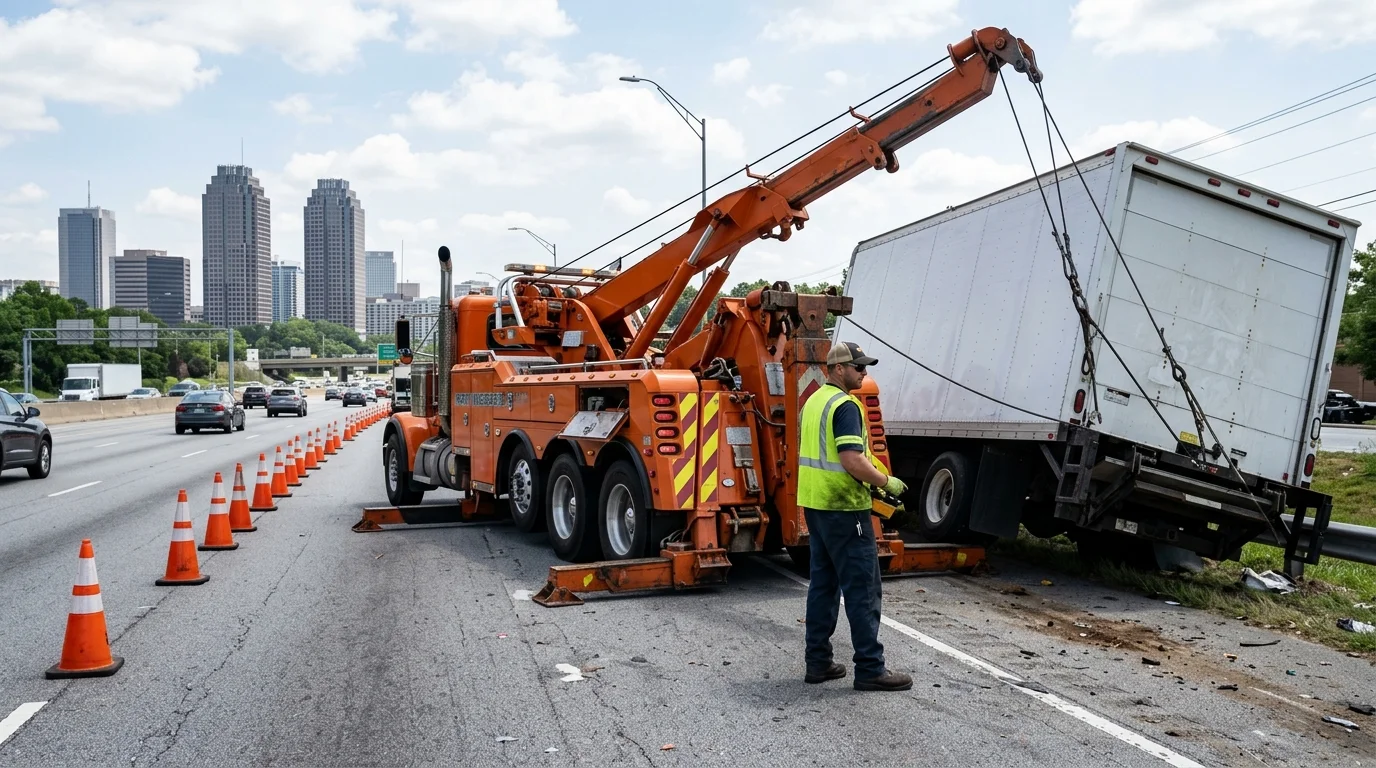
A loaded box truck on the I-285 shoulder is a different job than a sedan with a flat. The operators we dispatch bring a heavy wrecker sized to the truck’s GVWR, the cargo, and whether a lane is blocked. If you’re sitting on I-75 or the Perimeter with a commercial vehicle that will not roll, you need heavy-duty towing in Atlanta.
What counts as heavy-duty on Atlanta interstates
On Atlanta’s interstates, heavy-duty means a vehicle a light wrecker cannot lift or control. A 26-foot box truck, a dump truck, a bus, a roll-off, or a tractor-trailer all sit in that class. Check the door sticker for GVWR. If that number is over 10,000 pounds, you’re in the heavy-duty class.
Georgia’s published non-consensual ceiling is written for vehicles 10,000 lbs GVWR or under. Georgia DPS Maximum Rate Tariff No. 5, effective June 17, 2024, caps that class at $228 to tow, $33 a day for storage after the first 24 hours, and $91 in notification charges. Those figures are state ceilings for non-consensual tows. They are not brand prices, and they do not describe a loaded tractor-trailer on I-75.
A consensual commercial call, the kind a driver or a fleet desk makes from the Connector, has no published heavy-duty ceiling in the sources we can cite. The operator we send quotes the job before dispatch. That quote is the price. We do not set a brand rate, and we do not publish a per-mile figure for this work.
The Downtown Connector on I-75/85 carries 400,000-plus vehicles a day. I-285, the Perimeter, is a 64-mile loop. A Class 8 tractor sitting in a gore at Spaghetti Junction needs a heavy wrecker. Sending a wheel-lift to that scene sends the wrong truck and can damage the unit.
Name the body style when you call: box, dump, tanker, bus, or tractor with trailer. Say if the combination is still coupled. A bobtail tractor is one recovery. A loaded 53-foot van is another. The operator sizes the wrecker from those facts, and from the word “tow” alone. A Class A motorhome or a fifth-wheel is RV towing on I-75, not a box-truck recovery.
Spaghetti Junction, the Downtown Connector, and I-285 recovery
Spaghetti Junction is the Tom Moreland Interchange, where I-285 meets I-85 on the northeast side. Ramps stack. Sight lines are short. A disabled trailer on a flyover can block more than one movement at once, so cones and a taper have to go down before anyone puts steel on the truck.
The Connector through downtown is a different kind of tight. GDOT counted 3,353 crashes on the Connector in 2024. DeKalb County logged 35,860 crashes that same year, per GDOT. Those counts are why a box truck against the wall at the Grady Curve, or a tractor in the Brookwood split, becomes a lane-control job before it becomes a tow.
GDOT HERO patrols the metro freeways. HERO units push disabled vehicles out of live lanes, set a buffer, and help stranded drivers. They do not tow a truck to a shop. After HERO or police have the scene, you still need an operator with a heavy wrecker if the vehicle has to leave the interstate.
I-285 recovery changes by quadrant. The northside between GA-400 and I-75 runs past Perimeter office towers. The southside near Hartsfield-Jackson is airport freight, rental lots, and College Park. The westside at I-20 is warehouses and through-traffic. A shoulder in Doraville is a different call than a shoulder at the airport. Tell dispatch which arc of the Perimeter you’re on.
If you only need a local wrecker for a car, read how to get a tow truck near you in Atlanta. For a tractor, a loaded box, or a bus, ask for heavy-duty by name. Peach Pass express lanes add a second problem: a stopped truck in a barrier-separated lane has nowhere to drift. Say whether you’re in the Connector, the Perimeter, I-75 mainline, or an express lane, and name the nearest exit. Emergency towing Atlanta on these roads is often this scene: a commercial vehicle, live traffic, and no room to wait.
Winch-out versus a full wrecker
A winch-out is for a truck that is off the pavement but still in one piece. Median, ditch, soft shoulder, or a jackknife that dropped the trailer into the grass. The operator anchors, pulls, and stands the unit back on the roadway. Then you decide if it rolls to a shop or needs a haul.
A full wrecker job is the haul. The tractor will not roll, an axle is gone, or the truck is against the barrier on the Connector and has to be lifted. That work is accident recovery, and it is a heavy wrecker job.
Do not yank a commercial vehicle out with a pickup and a strap. The mass is wrong, the recovery points are wrong, and you can dump the load into a travel lane. On I-75 and I-285, that is how a private breakdown becomes a second crash.
If police ordered the tow, you are in a different lane of Georgia law than a call you placed yourself. A City of Atlanta police-ordered tow is capped at $125 with no storage for the first 24 hours under Atlanta Code § 162-227. That cap is a city impound figure. It is a separate number from a consensual heavy wrecker on the Perimeter, and from the DPS ceiling for a private-property tow of a light vehicle.
A private-property tow from a yard or a dock is a third situation, under O.C.G.A. § 44-1-13. This page is the interstate call: you asked for the truck, or the scene needs a heavy wrecker and a haul. Keep those three situations straight when you talk to dispatch. The paperwork and the bill follow the situation.
If the frame is bent or a trailer is on its side at Spaghetti Junction, the operator treats it as a recovery, then a haul. You describe the scene. The operator picks the truck.
What dispatch needs: GVWR, cargo, and lane blocking
The operator we send cannot guess the truck from an exit number alone. Read the GVWR off the door sticker, or name the class if you know it. Say whether the unit is loaded, empty, or leaking. Name the cargo in plain words. A dry van of freight is one job. A tanker is another. If you do not know what is in the trailer, say you do not know.
Lane blocking changes the truck that rolls. A unit fully on the shoulder is a recovery. A unit with duals in the right lane of I-75 is traffic control plus a tow. Give the direction: Florida-bound I-75 through Stockbridge and McDonough, or Tennessee-bound through Marietta and Kennesaw. Give the nearest exit and which side of the roadway.
Photos help. A picture of the door sticker, the landing gear, and the lanes around you tells the operator whether they need one heavy wrecker or a more involved setup. Quick Tow Atlanta is a referral line. We match you with an independent licensed operator. We do not own rotators. We do not run a fleet, a yard, or a storage lot.
Price is quoted before dispatch. For what that quote is weighing, read tow cost in Atlanta. The $228 DPS ceiling applies to non-consensual tows of vehicles 10,000 lbs GVWR or under. A heavy-duty rate cap for interstate commercial recovery could not be confirmed from the sources we use. The operator’s quote is the figure that matters.
If this started as a crash, say so. Airbags, spilled cargo, and a police unit on scene all change the recovery. If it is a mechanical failure and the truck is fully out of the lane, say that too. Short, true details get the right wrecker. “Southbound I-285 at GA-400” is usable. A city name by itself is thin.
Long haul south to McDonough and north through Marietta
I-75 is the long spine of this metro. South of the Connector it runs through Clayton and into Henry County. Stockbridge and McDonough take a lot of Florida-bound freight that broke down on the southside. North of downtown the same highway climbs through Midtown, crosses I-285, and heads through Marietta and Kennesaw in Cobb toward Tennessee. I-575 peels off for Cherokee County.
We serve Fulton, DeKalb, Cobb, Gwinnett, and Clayton, plus the outer ring as long haul: Cherokee, Henry, Douglas, Rockdale, Fayette, and Paulding. A tractor that dies on south I-75 and needs a shop in Gwinnett is a different dispatch than a local hook on the Connector. That haul is long-distance towing. The operator quotes it as a commercial move.
Marietta and Kennesaw sit on the north I-75 commercial strip. Warehouses, dealers, and through-freight stack there. McDonough and Stockbridge do the same work on the south end. Neither is downtown. Travel time on I-75 at rush is not a promise we can make, and we do not publish arrival times.
If the truck can be made rollable, the operator may winch, then haul. If it cannot roll, the combination has to move on the heavy wrecker or on equipment the operator brings. Tell dispatch the destination: a dealer in Marietta, a yard in McDonough, or the next safe exit. The quote follows the miles and the equipment, and it is given before anyone rolls.
Do not assume a Cobb or Henry office uses Atlanta’s $125 police-tow cap. Counties run their own process. We have no published administrative fee for Cobb, Gwinnett, Clayton, or the outer ring, so we do not print one. For a consensual long haul, you are in a quoted commercial recovery. Say the county and the shop name if the truck left the Perimeter for Fayette or Douglas. The operator we dispatch plans the route from that, and from a generic towing Atlanta pin.
When to call us
Once the truck is in a live lane, on its side, or too heavy for a passenger wrecker, this is not a job you pull yourself. The line is answered 24 hours a day in English and Spanish. Calls are recorded after a notice. An independent local operator gets dispatched to you. Call us at (678) 379-5984.